Sossusvlei, Fish River Canyon & Kolmanskop
Duration
Highlights
Per Person Sharing
Departs




Safari Description
This 6-day tour offers an ideal overview of Southern Namibia. Starting in Swakopmund, we head south to explore the breathtaking Namib Desert, crossing the Tropic of Capricorn. Our next stop is Sossusvlei in the Namib Desert, home to some of the world’s highest sand dunes. Continuing to Namibia’s deep south, where breathtaking landscapes abound, we visit the ghost town of Kolmanskop, spot the wild horses of the Namib Desert, and gaze over the Fish River Canyon, before ending an incredible 6-day trip with the last night at the impressive Quiver Tree Forest before returning to Windhoek. This is the ultimate Namibian adventure for the budget traveller!


Full Itinerary
Day 1: Friday – Swakopmund – Sesriem – 350 km
This morning, our guide will collect us from our accommodation in Swakopmund at 11:15, and we aim to leave by 11:30. This allows you to have a last wander around town or even take in another activity before we leave the coast.
From Swakopmund, we head east into the desert. We first cross the Namib gravel plains, large areas of flat and seemingly barren terrain broken up by huge mountain inselbergs. We have two mountain passes to traverse this afternoon, the first is the mighty Kuiseb Pass, and we follow the road from the top of the mountains, dropping steeply down into the canyon carved over aeons by the Kuiseb River on its way to debouch into the ocean at the port town of Walvis Bay. We climb up from the banks of the river and over the pass, travelling through the mountain peaks and on to the second, smaller canyon of the Gaub River, a tributary of the Kuiseb. We emerge from the mountains onto a flat road, and almost immediately we cross the Tropic of Capricorn at 23.5 degrees south. There is a signpost at this auspicious spot, and we stop along the road for photos. From here, we continue on through the desert landscape to the tiny town of Solitaire, where we can stretch our legs and sample the apple pie that has made this homestead famous. Onwards again to our destination for today, the gateway to the dunes and Sossusvlei at Sesriem.
We make our campsite in the shadow of the towering red dunes of the world’s oldest desert. In the late afternoon, there is the option with which to start our time in the world’s oldest desert. A short drive will take us to Elim Dune for the best golden light before sunset. From here, if you would like to, it is a relatively short walk back, through the desert, to our camp.
Accommodation: Twin-share tents, shared ablutions at the campsite.
Meals: Breakfast, Lunch & Dinner
Day 2: Saturday – Sesriem – Sossusvlei – Sesriem – 120 km
Sunrise in the dunes is the name of the game this morning, and that means a pre-dawn start. Our first stop will be at Dune 45, so named because it is 45 km from Sesriem. We will cover this first distance in darkness and early-morning twilight.
The best time to photograph the dunes is around sunrise and sunset. This is when you can see towering dunes illuminated a glowing orange, apricot red on one side and swathed in shadow on the other. The depth of field is spectacular at this time of day. We arrive at Dune 45 and climb to a vantage point for sunrise, watching as the colours shift with the ever-changing light. Back to the vehicle for a quick breakfast, then continue for the last few kilometres to the 2×4 car park, where we board the 4×4 shuttle vehicles into the vlei. From here, we enter the ancient Tsauchab River-bed for the last 5km leg to Sossusvlei itself.
The Tsauchab River is ephemeral; it only flows seasonally, when there is enough rain, and for the most part, the river-bed is dry. Aeons ago, during these rare floods, the Tsauchab sometimes received enough water to flow all the way to the Atlantic Ocean. However, as the millennia passed and the dune fields began to form (around five million years ago), wind-blown sand invaded the riverbeds. The rivers became more and more constricted by sand, until eventually the occasional floods could not break through the sand barriers that the wind had erected. The valley we drove along this morning in the darkness is kept free of sand by the Tsauchab, but Sossusvlei is now permanently water’s end.
Sossusvlei still occasionally floods (perhaps once every decade). After heavy rains in the Naukluft Mountains, where the river rises, Sossusvlei can become inundated, and the lake that forms can last for many months. However, the river can no longer follow its original path to the Atlantic.
The 4×4 shuttle service will transport us through the sandy riverbed terrain. We will visit Dead Vlei on foot, led by our guide. An ancient pan surrounded by sand, it is strikingly populated with dead, skeletal camel thorn trees. These trees have been a feature of this landscape for over 1000 years. Sossusvlei is almost surrounded by dunes, just one narrow path kept open by the Tsauchab River. We have time to explore the area on foot and climb one of the highest dunes in the world, some towering 300 m above us; the views are breathtaking and well-known.
We drive back to Sesriem for lunch and perhaps a dip in the swimming pool, and in the afternoon we take a short excursion to see the Sesriem Canyon. Only 4 km from our campsite, this canyon has been carved by the Tsauchab River. Around two million years ago, there was an ice age in Europe. This caused glaciers to form and resulted in a worldwide drop in sea level. The knock-on effect of this at Sesriem Canyon was that it increased the length and water flow of the Tsauchab River. The greater force of water enabled the Tsauchab to cut through the terrain, forming the canyon we see today. We can easily walk into the river-bed, it is usually much cooler in the canyon, and we can follow the river for some way along its journey to Sossusvlei.
Accommodation: Twin share tents, shared ablution at campsite
Meals: Breakfast, Lunch, Dinner
Day 3: Sunday – Sesriem – Klein Aus Vista – 350 km
We have a scenic drive today through ever-changing desert scenery, mountains and open grassland. We are continuing our long drive south, and our destination is the tiny community of Aus, located in the Aus Mountains above the plains of the Namib Desert. Aus was formally the site of a prisoner of war camp set up by the South African army to house German prisoners during the Second World War.
Our destination today is Klein Aus Vista, located just outside Aus and within the private Gondwana Sperrgebiet Rand Park. We aim to arrive in the early afternoon and set up camp at our cabin between the mountains, giving us time to stretch our legs on the property’s unguided hiking trails. The landscape offers wide-open vistas, and we hope for a spectacular sunset.
Accommodation: Twin share tents, shared ablution at campsite
Meals: Breakfast, Lunch, Dinner
Day 4: Monday – Klein Aus Vista – Luderitz – Klein Aus Vista – 250 km
We start early again, but with the luxury of a proper sealed tar road today. We travel through grasslands and wide-open desert scenery on our easy drive toward the ocean. Desert-adapted horses run wild in this area, and we need to keep a close lookout for these animals. Horses are not part of the true desert ecosystem, and their origins here remain speculative. Perhaps they are descended from the German cavalry lines during the First World War. It is also documented that Hans Heinrich von Wolf, owner and resident of Castle Duwisib in 1909, was a keen horse breeder. Maybe the origins of the horses today come from his bloodstock escaping their stables at Duwisib. Whatever their true history, it is a privilege to see these animals in their wild habitat.
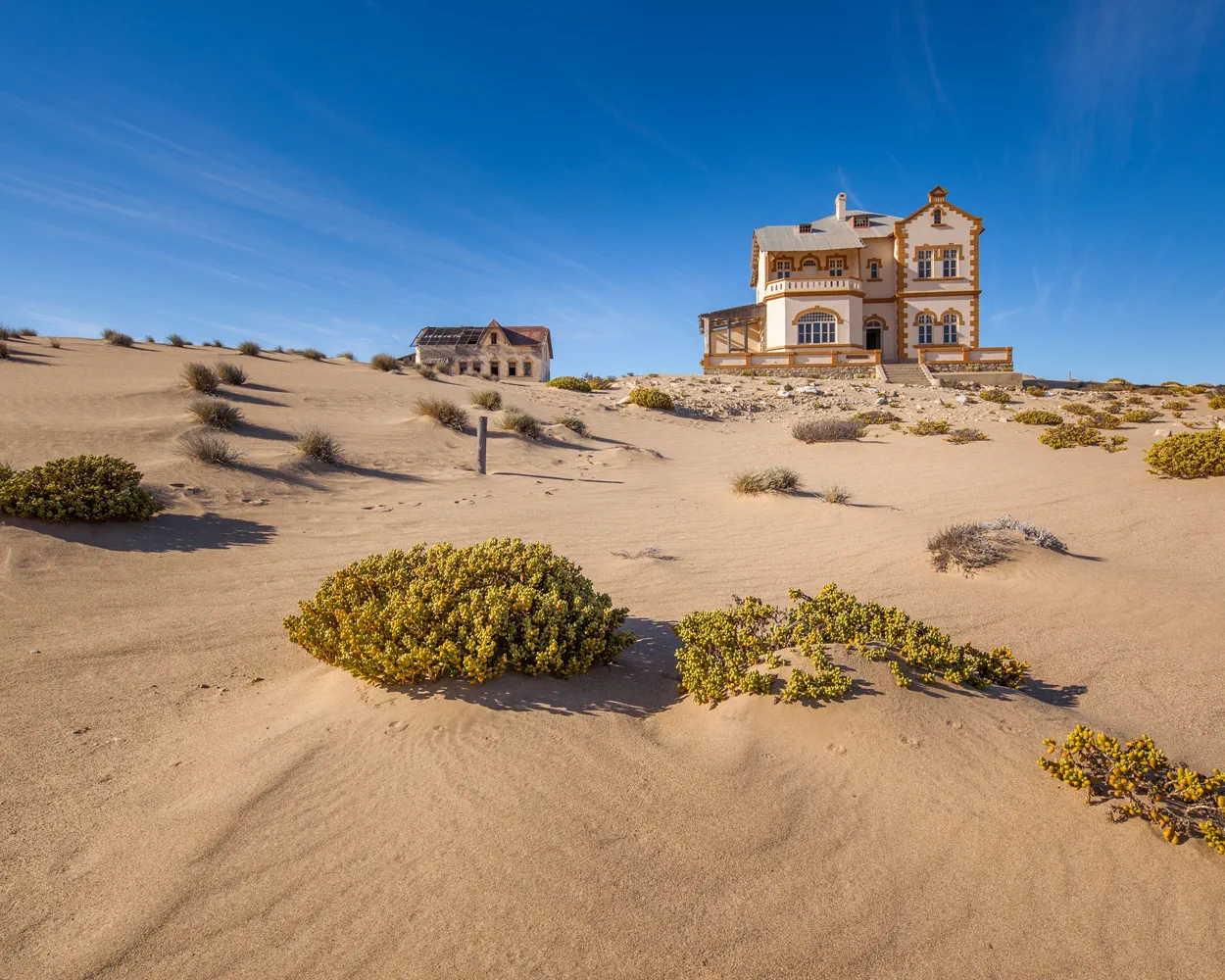
We are en route to the ghost town of Kolmanskop, about 15 km from the port town of Luderitz. For centuries, among early mariners, there have been rumours and stories of untold riches to be found on one far-flung coast or another. Most often, these claims proved to be just stories, but in the far south-west of Namibia, they were true. When diamonds were first discovered here, you could literally walk along the beach and fill your pockets with these precious stones. The first diamond mine was called Kolmanskop. Founded in 1908, it was built in the architectural style of a German village and equipped with the most modern amenities of the era. There was a hospital that boasted the first X-ray machine in the Southern Hemisphere, a power station, a school, a ballroom and an ice factory. The decline of Kolmanskop started around 1920 when the diamonds began to run out. Then in 1928, the richest diamond deposits that the world had, at the time, ever known were discovered 270 km away to the south at the Orange River. Kolmanskop became deserted, and the town began to be reclaimed by the desert.
Still a striking sight today, Kolmanskop is a must-see, and we will stop for a guided tour of the town and the opportunity to photograph this unique site. After departing Kolmanskop, we quickly cover the last few kilometres to Luderitz, well known for its unique and colourful colonial-style buildings. We drive out to the Luderitz Peninsula and take in the scenery en route to the historical monument at Diaz Point. As at Cape Cross, the first sign of European interest in this land was from the Portuguese and in this case, it was the navigator Bartolomeu Diaz who landed here in 1487 and caused a stone cross to be erected. This time, the name given to the area was Angra das Voltas or ‘Bay of Tacks’, about the many times Diaz had to ‘tack’ his ship against the southern gales. Luderitz is still one of the windiest places on Earth, so some things have not changed over the centuries.
We head back to our accommodation at Klein Aus Vista, taking a second opportunity to see the desert horses and arriving in time for a sundowner.
Accommodation: Twin share tents, shared ablution at campsite
Meals: Breakfast, Lunch & Dinner
Day 5: Tuesday – Klein Aus Vista – Quiver Tree – 550 km
A long drive today, but we take advantage of the tar road for the first part of the morning. We are heading east, but we will soon turn south again to complete our traverse of Namibia’s southern region. Our first main stop this morning will be the incredible Fish River Canyon, located in the /Ai-/Ais Richtersveldt Transfrontier National Park. We enter the park at the Hobas gate, and from there it is only a short drive to the main lookout point over the Fish River Canyon.
Second only in size to the Grand Canyon in Arizona, the vistas across this most immense of nature’s sculptures are breathtaking. From our vantage point high up on the plateau, we overlook the so-called ‘Hell’s Bend’, which takes the form of a huge meander along the course of the Fish River. The canyon is approximately 160 km long, 27 km wide at its widest point, and in places 550 m deep. The origins of the Fish River Canyon date back about 1,800 million years, and its formation can be attributed to nearly every geological force known. Huge seismic forces, volcanic eruptions, earthquakes, glacial activity, relentless erosion of every kind and finally, deepened by the Fish River that we can see glinting in the sunlight far below us. This is a perfect example of tortured rock that inspires our awe by its sheer massive size.
It is difficult to leave such an impressive sight, but we journey onwards, turning our heads once again to the north as the canyon marks the end of the southern leg of our trip. We are en route to Keetmanshoop, the main commercial and political centre of Namibia’s south—a short stop here and then on to our overnight camp at the Quiver Tree Forrest. Quiver trees are Namibia’s National Tree and are so named because the San tribes of Southern Africa used to strip the scaly bark from these trees and construct narrow cylinders from it. From this, they would manufacture a quiver in which to keep their poisoned arrows.
A quiver tree, despite its very tree-like appearance, is, in fact, not a tree at all. Its real name is Aloidendron Dichotomum (formally Aloe Dichotoma), and so is an aloe, and an aloe is a plant and not a tree. This does not diminish the impact they have on the landscape; weird and wonderful shapes abound in this collection of around 250 quiver plants/trees/aloes. The oldest specimens here are estimated to be about 200 years old, and they may reach up to 300 years old. Dating a quiver tree, however, is difficult, as it does not have rings of bark to count, the centre of the tree is fibrous, and there is really no established method of ageing.
The campsite tonight is a rustic camp, but we have the great benefit that it is within the Quiver Tree forest. This offers a stunning sunset and the opportunity for night photography. This is the last night of our safari, and it’s time to reflect on our amazing adventure as we sit around our campfire one last time.
Accommodation: Twin share tents, shared ablution at campsite
Meals: Breakfast, Lunch, Dinner
Day 6: Wednesday Quiver Tree Forrest – Windhoek 500 km
We head north today, and we have the luxury of the main tar road for our whole journey, no gravel road ‘African Massage ’to contend with, as we head back to Windhoek.
Namibia is so rich in interesting things that it is impossible to drive for any great distance without passing places of interest, and there are several worth mentioning along the way today. About 80 km from Keetmanshoop, we can see a tall mountain peak in the distance, off to the west. This is Brukkaros, another volcano, but quite an unusual one. Brukkaros formed around 180 million years ago, when molten magma from deep below the surface was pushed upward, intruding into the overlying, relatively soft sedimentary formations that covered the surface. Molten magma intrusions are common in worldwide geology, but what makes Brukkaros unusual is that in this case, the upward-moving magma hit an underground lake, leading to a colossal explosion powered by superheated steam. What was left formed a hollow cave, which was once the magma chamber, but with an overhead ‘caldera’ forming a partial roof. 80 million years later, the weight of the caldera was too much, and it collapsed into the magma cave.
Brukkaros is 1,590 m tall at its highest point, and the collapsed caldera measures about 4 km in diameter. The mountain itself is 650m higher than anything else in the area, and the crater floor is 350 m below the rim. Steam-formed volcanoes are very rare, and although Brukkaros is too far away to be included on this itinerary, it is a fascinating landmark to look out for on our drive today.
About 150 km into our long road today, we will pass a signpost to a place called Gibeon. Again, like Brukkaros, Gibeon is too far away to be included in this itinerary, but there is an interesting story that is worth telling.
Near here, in ancient prehistoric times, the area around what is now Gibeon was struck by a meteor of significant size. The meteor, when intact, was thought to measure 4 x 4 x 3 meters, and we know that it was made of solid metal. As it entered the earth’s atmosphere, the metal began to melt, and in due course, the meteor fragmented in a huge explosion, scattering chunks of molten metal across the countryside. Meteors from this event have been found as far away as Brukkaros Volcano to the south and as far away again towards the north. Still, the greatest concentration of meteor material has been found in and around Gibeon.
If you have time in Windhoek after our safari, it is worth going to Post Street Mall in the city centre, where you will find a public display of Gibeon Meteorites
Still heading ever north, our journey today takes us through the small centres of Mariental and Rehoboth, and we will stop along the road today for a light lunch. We aim to be back in Windhoek in the late afternoon.
You will be dropped off at your accommodation within the Windhoek City limits.
We recommend that departure flights are not scheduled for today.
Accommodation: None
Meals: Breakfast, Lunch